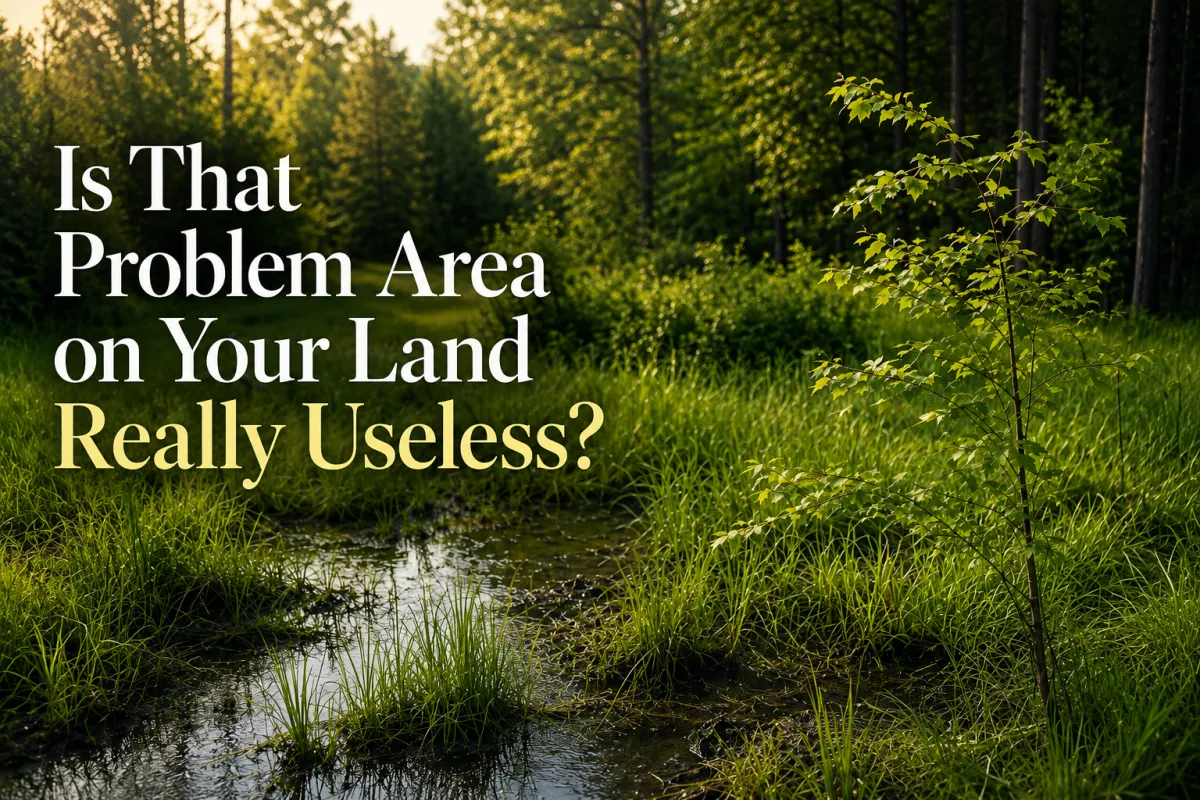
Is That Problem Area on Your Land Really Useless?
Is That Problem Area on Your Land Really Useless?

There are parts of our property that would be easy to call useless.
They stay wet. They grow thick. They are difficult to reach, difficult to mow, and difficult to shape into the kind of neat space people often picture when they think about useful land.
For years, I could look at those areas and mostly see what I could not do with them.
I could not easily plant a garden there.
I could not build there without spending a significant amount of money.
I could not drive across them whenever I wanted.
They did not look productive in the traditional sense. They were not making money, growing vegetables, holding livestock, or providing a convenient place for people to gather.
But the longer I observed the property, the more I realized something important.
Those areas were not useless.
They were simply not organized around human convenience.
The Deer Already Found a Use for It
Deer regularly use these parts of our property.
In fact, I have a doe that hides her fawn within 50 yards of our house. I often see her feeding in the front or back yard.
I saw the little one about a week ago while I was reclaiming a grass field with a disc. Once I realized the fawn was nearby, I stopped. The little one is safe, and I can return to that project in a couple of weeks.

The deer move through the cover, rest where they feel protected, and travel between the woods and more open areas. What looks overgrown and inconvenient to us may feel safe and useful to them.
Rabbits use the cover too.
They stay close to the thicker vegetation, then come out around the edges to feed. Those edges matter because they offer both food and a quick retreat.
To a rabbit, a clean, open field may not always be an improvement. It may be a dangerous place with nowhere to hide.
To a deer, an uncleared area may provide shelter, travel routes, bedding areas, and distance from human activity.
The land was already serving a purpose. I simply had not included wildlife in my definition of usefulness.
Human Usefulness Can Be Expensive
We once considered what it would take to make some of these areas more traditionally useful for people.
The answer involved heavy equipment.
Bringing in a bulldozer, clearing vegetation, reshaping the land, improving access, and dealing with drainage could have cost us more than $20,000.
I know because I cleared another part of the property about three years ago. I spent approximately $20,000 on that project.
Now, nearly half of it is growing back because my brush hog broke and I have not been able to maintain it as planned.
Should I have cleared it?
Time will tell.
What I do know is that clearing the land did not create a finished space. It created a new area that required equipment, time, fuel, and continued maintenance.

Even after spending that money, we still needed to decide what to do with the cleared area.
Would we plant it?
Fence it?
Build on it?
Maintain it?
Mow it?
Try to keep it dry?
The bulldozer did not create a finished solution. It only changed the starting point.
That raises an important question:
What were we really buying for more than $20,000?
We gained more open ground and easier access. But we may also have lost wildlife cover, natural drainage, privacy, shade, habitat, and an area that required very little from us.
The true cost was not only the money paid to the equipment operator.
The cost may also have included everything the land was already doing before we changed it.
I enjoy watching wildlife from my back porch, so I have learned to embrace some of the spaces I once considered unused.
This is one of the main ideas behind the Read Your Land Before You Spend ShortCourse. Before clearing, building, fencing, planting, or investing, it helps to understand what the land is already doing and what may be lost when it changes.
You can learn more about the ShortCourse and available bundles at GreentownGardens.com/Courses.
Unmonetized Does Not Mean Unused
Landowners often feel pressure to make every acre produce something visible.
A garden.
A pasture.
A cabin.
An RV site.
A pond.
A rental.
A crop.
A business.
Those may all be worthwhile ideas in the right place. But when we only count visible human production, we can miss other forms of wealth.
An area may be creating land wealth by holding soil, slowing water, supporting trees, or protecting another part of the property.
It may be creating mental and physical health wealth by giving us privacy, quiet, wildlife sightings, and a place that feels less managed.
It may be creating family wealth by giving children and grandchildren a place to explore and see animals in a natural setting.
It may be creating freedom wealth because we are not paying to clear, build, mow, repair, or maintain it.
It may even preserve future choices.
A part of the property left alone today can still be reconsidered later. A part that has been cleared, drained, filled, or built upon may be much harder to restore.
Sometimes one of the most valuable things land gives us is the freedom not to decide yet.

The Edges May Be Doing More Than You Think
The rabbits on our property remind me that edges are often especially valuable.
They use the cover for safety and the open areas for food. The transition between the two gives them both.
Many animals use these transition zones. Birds move between trees and grass. Pollinators use flowering plants along field edges. Deer travel between dense cover and feeding areas.
People sometimes look at these areas and see disorder.
Nature may see shelter, food, movement, and protection.
That does not mean every overgrown area should remain untouched forever. It does mean we should understand what is happening before we remove it.
Useless to Whom?
When we say that part of a property is useless, we should finish the sentence.
Useless to whom?
Useless for what?
Useless right now, or useless forever?
An area may be poorly suited for a garden but well suited for wildlife.
It may be difficult to build on but excellent for holding water away from another part of the property.
It may not create direct income, but it may save thousands of dollars in clearing and maintenance costs.
It may not support the project we imagined, but that does not mean it has no value.
Sometimes the real problem is not the land.
Sometimes we have chosen a use that does not fit the land.
What Are You Trading for What?
Before changing one of these areas, I believe a landowner should ask:
What am I trading for what?
If I clear this area, what do I gain?
What disappears?
What new work will I create?
What will it cost to maintain?
What happens to the water?
Where will the wildlife go?
Will this change improve the whole property, or will it only make one section look more orderly?
And perhaps most importantly:
What if I succeed?
What if the bulldozer does exactly what I ask?
What if the area becomes open and accessible?
Am I prepared to use it, manage it, and maintain it for years?
Success still creates responsibility.
Observation Is Part of the Work
Leaving an area alone does not have to mean ignoring it.
You can walk it.
Watch where the animals enter and leave.
Notice what grows there.
Look at how water moves after a heavy rain.
Observe which parts stay wet and which dry first.
Pay attention to tracks, trails, bedding areas, nests, burrows, shade, and natural boundaries.
Take photographs throughout the year.
An area that looks empty in January may be full of life in May. A dry-looking depression in summer may carry water across the property during winter rains.
One visit rarely tells the full story.
Observation is not procrastination. It is part of the work.
For landowners who are not sure where to begin, the introductory booklet Walk the Part of Your Land That Bothers You Most provides a simple starting point.
It helps you slow down, observe one difficult area, and begin asking better questions before spending money on it.
The booklet is available at GreentownGardens.com/Shop.
Your Land Does Not Have to Prove Its Worth
Not every acre has to make money.
Not every corner has to become a project.
Not every rough area needs to be cleaned up for people.
Some areas may be most useful when they are left largely alone.
That does not make them wasted.
The deer may already be using them.
The rabbits may already be using them.
The soil, water, trees, insects, birds, and other wildlife may be using them in ways we have not fully noticed.
Before spending thousands of dollars to make an area useful for people, take time to understand the wealth that may already be there.
Start with the land, not the idea.
Ask what the area is already doing.
Then decide whether changing it would create more value or simply replace one kind of value with another.

Small does not mean wasted.
Quiet does not mean unused.
Unmonetized does not mean unimportant.

