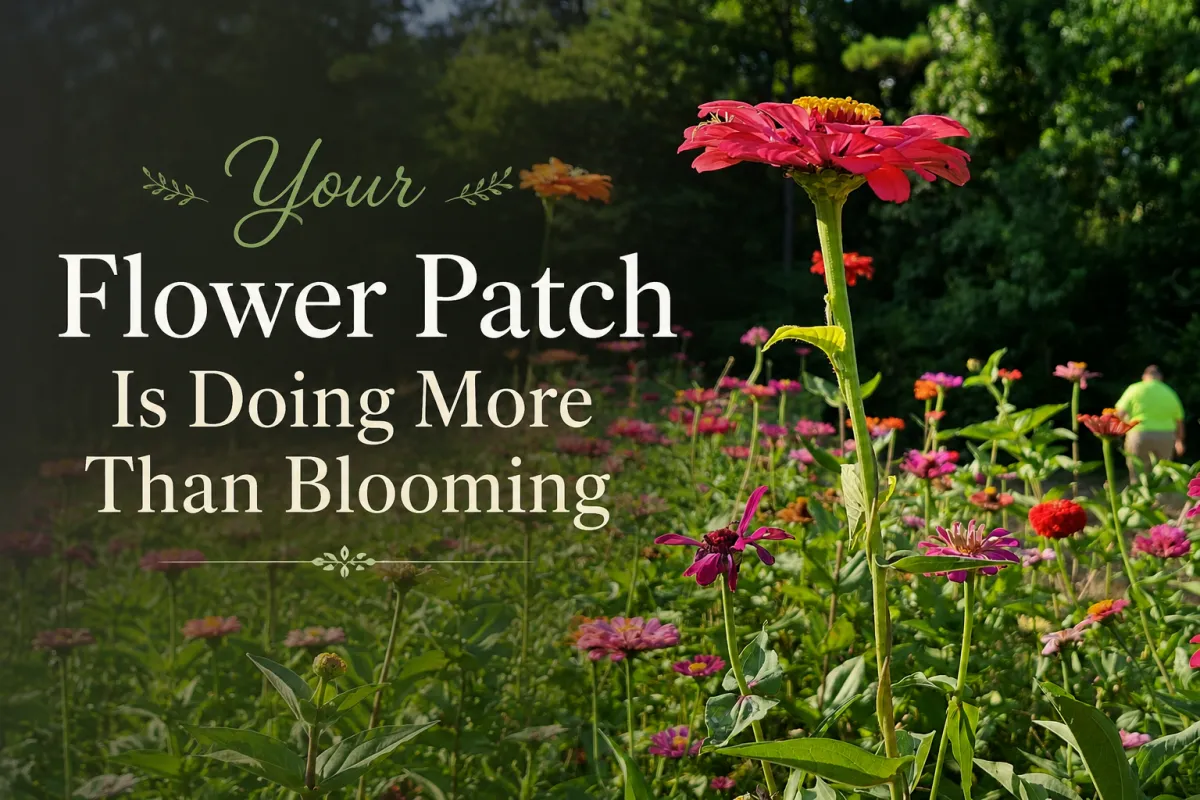
Your Flower Patch Is Doing More Than Blooming
Your Flower Patch Is Doing More Than Blooming
How simple flowers can support pollinators, wildlife, beauty, generosity, and small-land stewardship
Curated by Louis Green

A flower patch can be easy to underestimate.
At first glance, people may only see color.
A few zinnias. A row of blooms. A pretty place to take a picture. Something nice to cut for a jar on the table.
And yes, flowers are beautiful.
But at Greentown Gardens, we are learning that a flower patch can do much more than bloom.
It can feed pollinators.
It can shelter small wildlife.
It can invite butterflies, bees, wasps, spiders, inchworms, birds, and hummingbirds into the story.
It can give you beauty to share.
It can teach you to slow down and notice what the land is already doing.
A flower patch is not just decoration.
It can become habitat.

A Flower Patch Is a Living Space
When we planted zinnias, we knew we were planting flowers.
What we keep learning is that we were also planting a gathering place.
The blooms draw butterflies. They draw bees. They draw wasps and other pollinators. They give insects a place to feed, rest, hide, hunt, and move through.
And once the insects come, other wildlife notices too.
Birds watch the flowers. Hummingbirds and bluebirds use the zinnias for their own purposes. Spiders show up. Tiny caterpillars and inchworms appear on petals and leaves. Sometimes a bouquet comes inside with a brave little jumping spider tucked somewhere in the flowers.
That is the part a lot of people miss.
A healthy flower patch is not always clean, still, or perfect.
It is busy.
It is being used.
It is part of a food web.

Not Every Garden Guest Is a Butterfly
When people think about butterfly gardens, they usually picture butterflies first.
That makes sense. Butterflies are beautiful, easy to love, and fun to watch.
But not every garden guest is a butterfly.

A tiny inchworm on a zinnia may not be what someone expected to see, but it is part of the garden too. So are caterpillars, bees, wasps, spiders, beetles, birds, and other quiet visitors.
This is one of the lessons Greentown Gardens keeps teaching us.
If we only look for the pretty visitors, we miss the system.
A flower patch does not just support the wildlife we planned for. It supports the wildlife that already belongs to the land.
Some guests pollinate.
Some nibble.
Some hunt.
Some become food for birds or other wildlife.
Some simply remind us that the garden is alive.
That does not mean every insect is good for every plant all the time. Gardeners still have to pay attention. But stewardship starts with noticing before reacting.
Sometimes the best first question is not, “How do I get rid of this?”
Sometimes the better question is, “What is this doing here?”
Beauty Is Also Useful
A flower patch does not have to produce vegetables to have value.
That can be hard for practical people to accept at first.
We tend to ask land to prove itself. What did it produce? What did it sell? What did it feed? What did it earn?
Those questions matter, but they are not the only questions.
A flower patch may feed pollinators. It may support beneficial insects. It may give birds and small wildlife a place to move through. It may bring beauty into a hard day.
It may also help a person slow down long enough to notice the light, the weather, the bugs, the blooms, and the quiet work happening around them.
That matters too.
At Greentown Gardens, we often talk about land in terms of more than income. A piece of land can create food, peace, skill, beauty, family connection, community, and a deeper sense of stewardship.
A zinnia patch can do several of those things at once.

A Garden Can Grow More Than Flowers
Recently, we were asked to provide flowers for a wedding shower.
That was a sweet reminder that a garden can grow more than flowers.

A bouquet may not look like a traditional harvest, but it is still something the land gave.
Sometimes the harvest is not in a basket.
Sometimes the harvest is beauty for a table, color for a celebration, or something meaningful to share with someone else.
Garden-grown flowers do not have to be fancy to matter. They do not have to look like they came from a florist cooler. There is something special about flowers that came from a real place, were gathered by real hands, and carried into a moment that mattered.
That is part of the value of a flower patch.
It can feed the bees and brighten a room.
It can support wildlife and become a gift.
It can be both useful and beautiful.
You Do Not Need a Big Garden to Begin
One thing we want people to understand is this:
You do not need 40 acres to start.
You do not need a perfect field.
You do not need a fancy garden plan.
You do not need a polished flower farm.
You do not even need a large yard.
A small flower patch can begin with a little soil, a little sunlight, a packet of seeds, and a willingness to pay attention.
Zinnias are a good example. They are simple, cheerful, and generous. They do not require a perfect setup to be useful. A few zinnias in a small bed, a corner of a yard, or even a container can give pollinators something to visit and give you something to enjoy.

That is why we keep coming back to this idea:
Start with one flower.
One flower can make you notice the space differently.
One planter can invite a bee.
One small patch can become a place where butterflies stop, where children notice insects, where you begin to understand what your space can offer.
Stewardship does not always start with a big project.
Sometimes it starts with one bloom.
Imperfect Still Counts
A real flower patch will not always look perfect.
There may be weeds. There may be grass. There may be rough edges, dry spots, fading blooms, insect damage, and plants that grew somewhere you did not expect.
That does not mean the space is useless.
Sometimes beauty shows up uninvited.
Sometimes a volunteer zinnia grows in the grass where it does not technically belong, but it is still welcome.
Sometimes a rough patch feeds more life than a polished space.
At Greentown Gardens, we are learning not to mistake imperfect for useless.
A flower patch can still be valuable while it is messy. It can still support life while it is in progress. It can still teach you something while you are figuring out what to do next.
That is an important small-land lesson.
If we clear, mow, spray, or “fix” every imperfect space too quickly, we may remove something that was already doing quiet work.
What Your Flower Patch Might Be Doing
The next time you look at a flower patch, try not to stop at the blooms.
Look closer.
Ask what else is happening there.
Is something feeding?
Is something hiding?
Is something hunting?
Are birds watching the insects?
Are bees returning to the same flowers?
Are butterflies passing through?
Is a plant blooming where you did not expect it?
Is the space bringing beauty, peace, or curiosity into your day?
A flower patch may be doing more than you think.
It may be feeding wildlife.
It may be building habitat.
It may be giving you cut flowers to share.
It may be helping you learn your land.
It may be teaching you patience.
It may be giving you a reason to slow down and look again.
That is why we believe flowers are not just decoration.
They are part of the way we learn stewardship.

A Simple Invitation
Whether you have a large property, a small yard, a rented space, or one five-gallon planter on a porch, you can still grow something that matters.
Plant something simple.
Watch what visits.
Notice what changes.
Let your flower patch teach you.
At Greentown Gardens, we are still learning too. We are learning from the zinnias, the insects, the birds, the deer, the greenhouses, the weeds, the rough edges, and the surprises the land keeps giving us.
A flower patch can be more than pretty.
It can be a small classroom.
It can be a gift.
It can be habitat.
And sometimes, it can be the first place you begin to see your land differently.
Follow Along
If you enjoy garden notes, wildlife moments, flower photos, and small-land stewardship, you can follow Greentown Gardens here:
Louis on Facebook:
https://www.facebook.com/louis.green.92102
Karen on Facebook:
https://www.facebook.com/karen.reighney
Greentown Gardens on Pinterest:
https://www.pinterest.com/louis6226/
Thank you for visiting GreentownGardens.com.
